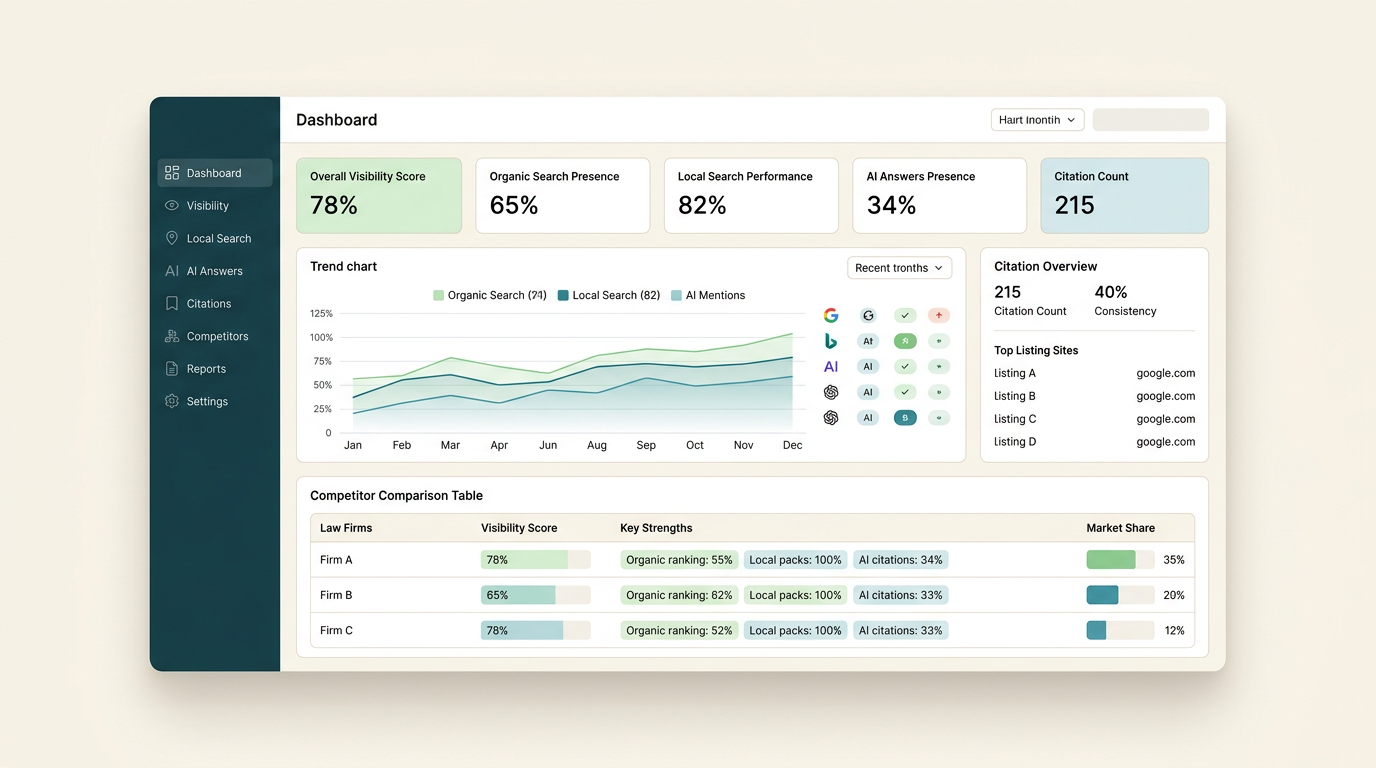
Receive a defined visibility assessment showing what was tested, what appeared and what may warrant correction. The process starts by checking the existing situation and the available evidence, not by assuming a particular AI tool is required. The right output is a clear decision record with owners, controls and the next review step.
What does AI-search visibility mean for law firms?
AI-search visibility describes what a defined set of AI-assisted answer experiences displays about a firm under stated testing conditions. The assessment is an observation exercise, not a prediction of future recommendations. Record the question asked, the service and geography it represents, the date, platform, displayed sources and any obvious omissions or misstatements.
A useful starting test is to write down the precise decision: What do a dated set of AI-search observations actually show about the firm, and what can be corrected? Identify the documents or people who can answer it and distinguish observed facts from assumptions. For the work component “Search-query sample and measurement rules”, record the minimum evidence required before recommending a tool or a process change.
How should an assessment choose and document its queries?
A reliable query set starts with real client questions and commercial decisions, then separates branded queries from service-category and location queries. Include alternative phrasings and note whether personalization or account settings may affect results. A handful of favorable prompts is not enough to represent general visibility; the selection rules should be documented before testing.
Turn this into a reviewable task by asking who owns “Evidence log of observed answers and source mentions”, which source records are current, and who may authorize the result. If the information comes from an AI output, verify it independently. A reviewer should be able to reject the result without losing the original evidence.
What can and cannot be concluded from observed AI answers?
An observed omission does not prove suppression, and a mention does not prove that an AI system endorses the firm. Answers can vary across repeated requests and updates. The assessment should preserve the evidence and explain uncertainty, rather than converting sample observations into unsupported market-share percentages or promises of improved recommendations.
The buyer should ask whether “Business profile and source-consistency audit” addresses a skill gap, an unclear handoff or a genuine software limitation. Those require different responses. Document who makes the final selection and what remains outside the engagement, especially where vendor settings or professional rules apply.
How website content and independent sources influence discovery
Primary site content, public business details, professional profiles and independent publications can disagree. Verify name, address, practice scope, jurisdiction and author identity against authoritative records before recommending edits. A useful improvement may be to correct an inaccurate profile or clarify a service page rather than generating many new near-duplicate pages.
For “Prioritized correction plan”, review a small, authorized sample first. Check that the wording fits the intended audience, that any jurisdiction-sensitive statements are grounded, and that confidential information has not been used without permission. Keep a corrected version and an explanation of why the change was necessary.
How to check whether a firm’s details are consistent
Construct a source-consistency sheet listing each factual firm attribute, its authoritative internal source and the external surfaces where it appears. Categorize differences as outdated, inconsistent, unverifiable or outside scope. Record when the information was accessed so the firm can distinguish an actual mistake from an answer that reflects an earlier public record.
Use the “Search-query sample and measurement rules” output as a handoff document: identify the next responsible person, the expected action and how completion can be checked. Record the route for uncertain cases instead of letting a system send a message or alter a file automatically.
How to prioritize changes without promising visibility
Prioritize changes according to significance and control: misleading legal claims and broken contact paths come before cosmetic wording changes. Some surfaces are not editable by the firm, so the plan should separate actions it can take directly from correction requests to publishers or directories. No provider can guarantee how a third-party answer system responds.
When evaluating “Evidence log of observed answers and source mentions”, use a simple evidence register with date, source, observed issue and follow-up owner. Do not convert unmeasured expectations into claims of improved quality or time savings. Establish the baseline and acceptance criteria before drawing a conclusion.
How to repeat measurements and document uncertainty
Repeat the same query sample periodically using a consistent protocol. Record changes to location, login status and model version where visible, and preserve screenshots or exported observations subject to platform terms. Compare like with like and retain baseline evidence; otherwise small fluctuations can be mistaken for material improvement.
An initial scope should specify what “Business profile and source-consistency audit” will examine, which information is unavailable, and what would cause the work to stop. Review the findings with a decision-maker; if a technical or legal specialist is required, record that dependency rather than treating the study as complete.
What would a useful assessment or implementation plan produce?
The following table is a proposed scoping framework. It helps a buyer distinguish a meaningful work product from an attractive demonstration. The actual deliverables and responsible reviewers should be agreed before information is shared or configuration begins.
| Work component | Evidence or output to inspect | Who reviews it |
|---|---|---|
| Search-query sample and measurement rules | Dated current-state inventory, owner and scope exclusions | Buyer/process owner |
| Evidence log of observed answers and source mentions | Source register, factual checks and alternative options | Source or professional reviewer |
| Business profile and source-consistency audit | Draft working map, documented tests and exception list | Appropriate legal/IT/security representative |
| Prioritized correction plan | Reviewer sign-off record, follow-up tasks and handover notes | Accountable decision-maker |
A four-step decision workflow
- Clarify the question: State the buyer decision and define what “Search-query sample and measurement rules” must resolve.
- Collect approved evidence: Gather approved records for “Evidence log of observed answers and source mentions” and label assumptions.
- Design and test: Prepare “Business profile and source-consistency audit” using bounded examples and explicit stop rules.
- Review and decide: Use “Prioritized correction plan” to make a go, revise or defer decision with a named owner.
Illustrative exercise (not a client case study): An assessor tests eight documented questions about one practice area, saves the displayed source references and records one inconsistent firm-description field for manual correction. This is a planning illustration; its suitability must be checked against actual agreements, governing law, user permissions and platform features.
Important limitations and safeguards
AI-search results are variable observations, not durable rankings or guaranteed recommendations. Sample size, location, personalization, product updates and access settings may affect the displayed answer.
Legal, privacy, security and operational obligations depend on jurisdiction, the nature of the information, the vendor's current documentation and the client's own policies. A training, assessment or process-design service does not itself authorize external disclosures, constitute a legal opinion, or prove technical fitness. Material decisions must remain with properly qualified and authorized people.
Frequently asked questions
Will this predict whether AI recommends our firm?
No. Research hypotheses, observed answers and pilot outcomes do not establish that a prospective customer is interested or that a third-party service will behave the same way later. The report should explain sampling, limitations and remaining uncertainty.
Which AI search tools are included?
A limited scoping and research phase can normally be considered separately from direct access or production configuration. The exact scope, platforms and people involved must be agreed. If specialist integration or privileged material is necessary, the engagement should stop for additional authorization.
How is the assessment different from SEO consulting?
Begin with public, synthetic or specifically approved data. The organization must decide whether confidential, personal or privileged information may be processed and under which terms and controls. Lawyers and responsible information owners should independently review consequential outputs before they are used.
What information do you need from our website?
This is a proposed decision-support and implementation-planning pathway, not an accreditation, vendor partnership, guarantee of results or automatic legal conclusion. The appropriate next step is to confirm the actual deliverables, limitations and reviewer responsibilities for receive a defined visibility assessment showing what was tested, what appeared and what may warrant correction..
Sources and verification
These primary or institutional sources support the research method and risk distinctions discussed here. Product-specific features, subscription eligibility and jurisdictional rules should be rechecked at the date of an actual engagement.
- Google Search Central — Helpful, people-first content — use for the stated research purpose, not as an endorsement.
- ABA Formal Opinion 512 — Generative Artificial Intelligence Tools — use for the stated research purpose, not as an endorsement.
Discuss a practical next step for your organization
Describe the problem, intended users, relevant systems and the decision you need to make. A suitable scope should be confirmed before any confidential information, vendor access or system change is requested.