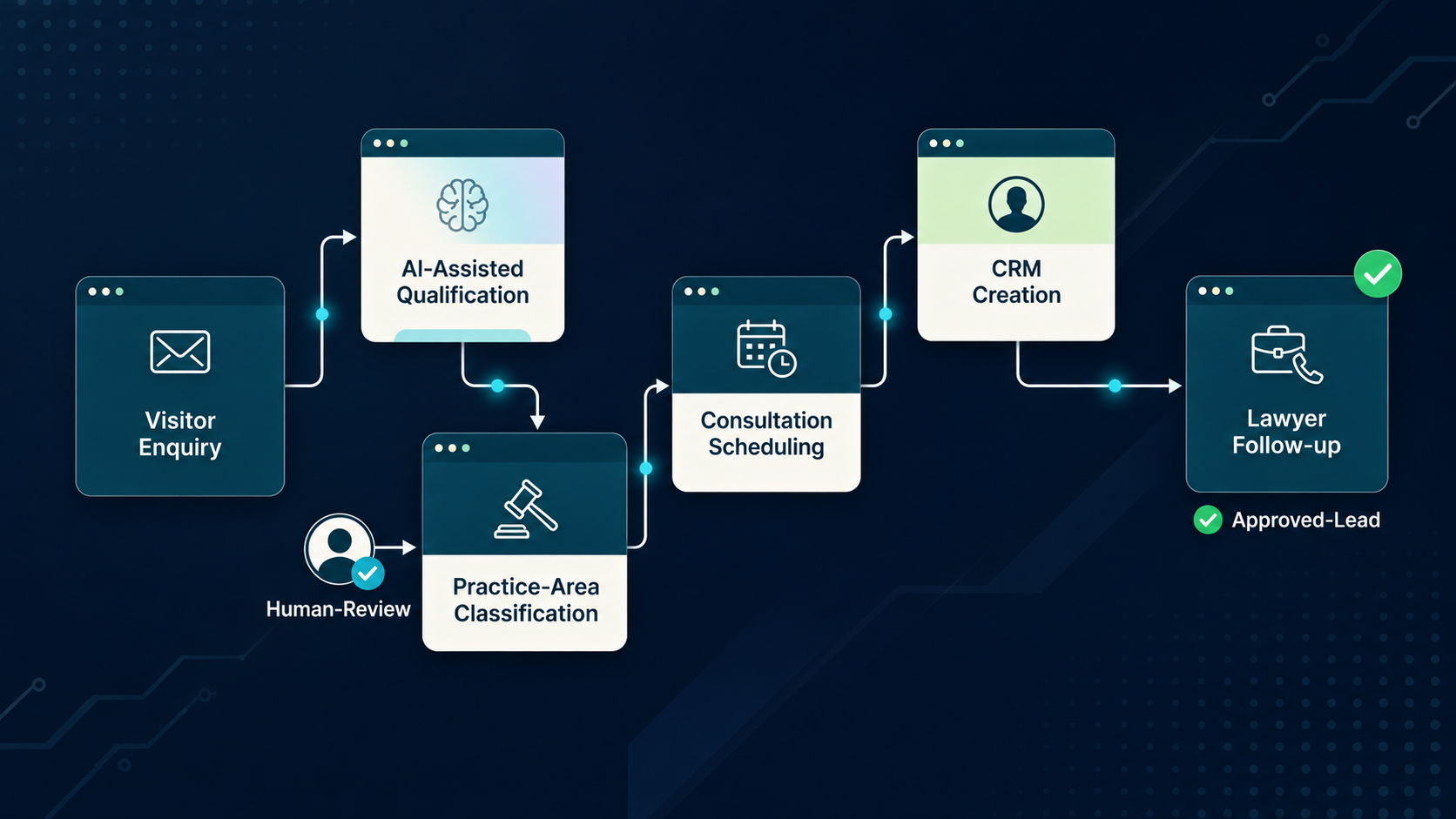
Choose the area where your team loses time, lacks clear evidence or needs a safer working process. Compare the associated service pages and contact TechCorpLegal to discuss the actual scope and responsible reviewers.
Marketing and visibility
AI Marketing Systems for Law Firms
Choose a practical route: assess your current process, train your team or configure a repeatable marketing system.
Find Out How AI Search Sees Your Law Firm
Receive a defined visibility assessment showing what was tested, what appeared and what may warrant correction.
Practical AI Workshop for Law Firm Owners
Leave a practical leadership workshop with a prioritized list of approved tasks and review responsibilities.
Training and practical adoption
Practical AI Training for Legal Teams
Select a role-appropriate programme that teaches practical tasks with source checking and human review.
Set Up a ChatGPT Workspace for Your Law Firm
Plan a shared workspace approach around approved tasks, suitable access and documented review.
Help Customers Start Using Your Legal AI Product
Plan product-specific training, practice exercises and customer feedback checkpoints.
Legal operations and connected tools
Help Legal Leaders Plan Connected AI Work
Use a facilitated workshop to agree on priority use cases, owners, approval steps and next actions.
Check Whether Your Contract System Can Work with Legal AI
Assess technical fit, information permissions and a realistic pilot path before attempting integration.
Design AI Tasks That Ask a Lawyer Before Acting
Design explicit checkpoints where AI pauses, records uncertainty and seeks human authorization.
See Where Legal Documents Go When AI Tools Connect
Map where information is entered, accessed, transformed, retained and reviewed so risks can be examined.
Set Clear Working Rules for Outside Law Firms
Create a clear proposed instruction framework that a client and its counsel can review and adopt.
Check Whether Your Legal Operations Data Is Ready for AI
Assess whether selected information is sufficiently reliable for a defined AI-supported task.
IP and business research
Find Potential Businesses to License Your Patents
Create a research-led list of potential application areas and organizations for further technical and legal review.
Move R&D Invention Information to Patent Teams Safely
Map an appropriate intake and disclosure workflow for patent teams without assuming automated ownership or legal conclusions.
Check the Quality of AI-Assisted Patent Research
Introduce a reproducible review process for patent evidence and research outputs.
Find Better-Fit Buyers for Your Legal-Tech Product
Build an evidence-led prospect research and prioritization process without implying buyer interest.
Training, assessment or implementation planning?
Training addresses what people know and whether they can complete approved tasks correctly. Assessment examines the current process or technology and produces a bounded evidence-based recommendation. Implementation planning maps the proposed workflow, permissions, tests and responsible owners before any live configuration. The most useful starting point depends on whether the problem is capability, process clarity or technical feasibility.
A team with suitable software but inconsistent working habits may need training and a short standard procedure rather than a new application. A department considering connected AI tools may need a data-flow and approval review before permitting any access. A patent owner seeking possible licensees first needs reliable claims and market evidence, not an automated sales sequence. These are different buyer decisions and should not be packaged under one vague promise to 'do AI'.
A simple checklist for choosing an AI service
- State one business problem in ordinary language and identify who owns it.
- Record the inputs, currently used applications, jurisdictions and expected output.
- Decide which information is public, internal, confidential or privileged.
- Check who will verify sources and approve consequential decisions.
- Ask for an evidence-based deliverable and an explicit list of exclusions.
- Use a small authorized test and define conditions that would stop the work.
- Document follow-up responsibilities instead of assuming a one-off workshop completes adoption.
For legal teams, the responsible professional must evaluate confidentiality, competence, supervision and jurisdiction-specific requirements. Tool demonstrations cannot establish these obligations for a particular matter. The service scope should make professional and technical dependencies visible before work begins.
How we distinguish evidence from vendor claims
Vendor feature descriptions explain what a company says its product supports; official documentation, service configuration and practical testing establish whether a feature can be used in a particular environment. Public patent databases support research about published applications and grants but cannot establish a business's willingness to license. AI search observations describe what was seen under stated conditions; they do not guarantee future answers. A meaningful advisory report should identify the evidence source and its limits for every consequential recommendation.
Where an engagement might require third-party account access, sensitive information, paid features or local legal advice, those conditions must be assessed separately. This directory does not imply partnership with vendors, legal accreditation or guaranteed commercial outcomes.
Reference methods and source material
- ABA Formal Opinion 512 — Generative Artificial Intelligence Tools
- NIST — Generative Artificial Intelligence Profile
- Google Search Central — Helpful, people-first content
- WIPO — Intellectual Property Commercialization Hub
These references support general evaluation and professional responsibility considerations. They are not commercial endorsements of TechCorpLegal.
Find the right next step
Explain the task you want to improve, the platform or documents involved and the stage of your current process. A suitable service scope is established through a separate discussion, with relevant technical and legal limitations made clear.