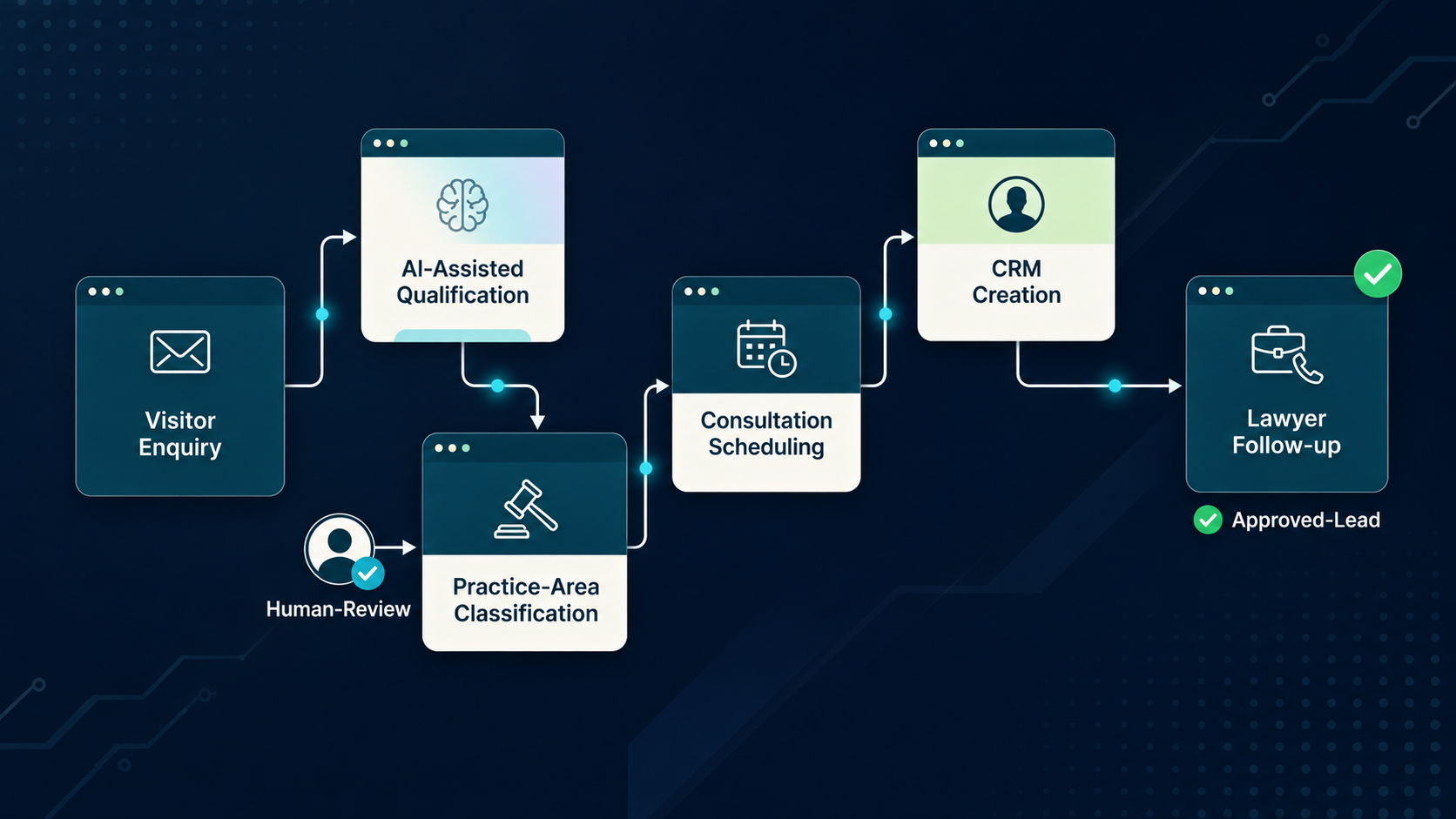
Design explicit checkpoints where AI pauses, records uncertainty and seeks human authorization. The process starts by checking the existing situation and the available evidence, not by assuming a particular AI tool is required. The right output is a clear decision record with owners, controls and the next review step.
What makes an AI legal workflow supervised?
A supervised AI workflow has a defined task and an identified person who can approve, reject or revise material results. A human should not be a ceremonial sign-off after the system has already acted. Define the system's permitted actions, what evidence it must show and which events immediately suspend further processing.
A useful starting test is to write down the precise decision: Where must an AI-enabled legal task stop and request meaningful human approval? Identify the documents or people who can answer it and distinguish observed facts from assumptions. For the work component “Workflow task and risk breakdown”, record the minimum evidence required before recommending a tool or a process change.
Which tasks need professional approval?
Professional approval may be needed before legal opinions, client advice, contract amendments, filing documents or transmission of sensitive records. Approval rules differ by organization and jurisdiction. Separate trivial internal formatting tasks from legally consequential decisions so supervision remains proportionate and practical.
Turn this into a reviewable task by asking who owns “Approval and escalation map”, which source records are current, and who may authorize the result. If the information comes from an AI output, verify it independently. A reviewer should be able to reject the result without losing the original evidence.
Defining stop conditions and exception routes
Stop conditions should cover missing sources, inconsistent records, privilege concerns, uncertain jurisdiction, unexpected external data requests and output outside defined scope. Each condition needs a named escalation route, not merely a vague 'refer to a human' note. Include how work is resumed, corrected or abandoned after an exception.
The buyer should ask whether “Exception and failure-handling rules” addresses a skill gap, an unclear handoff or a genuine software limitation. Those require different responses. Document who makes the final selection and what remains outside the engagement, especially where vendor settings or professional rules apply.
Maintaining a record of sources and decisions
Maintain enough of a record to reconstruct the decision: input sources and their versions, tool used, generated draft, warnings, reviewer, correction and final authorization. Retention itself must respect confidentiality and data-minimization rules. An audit trail that stores privileged content in the wrong system creates a new risk.
For “Test cases and review record”, review a small, authorized sample first. Check that the wording fits the intended audience, that any jurisdiction-sensitive statements are grounded, and that confidential information has not been used without permission. Keep a corrected version and an explanation of why the change was necessary.
Testing routine, uncertain and adversarial inputs
Tests should include routine inputs, missing data, contradictory documents and attempts to induce an unauthorized action. Evaluate both false negatives and false positives in escalation. Where possible, use an approved benchmark and have experienced reviewers explain disagreement so that failures lead to revised rules rather than cosmetic prompt edits.
Use the “Workflow task and risk breakdown” output as a handoff document: identify the next responsible person, the expected action and how completion can be checked. Record the route for uncertain cases instead of letting a system send a message or alter a file automatically.
Handling client confidentiality and access boundaries
Access rules determine whether a workflow can be operated safely. Limit each component to necessary permissions and test that users cannot reach information outside their roles. Resolve whether the system is allowed to retrieve, summarize, edit or transmit material; these are separate capabilities and require separate approval decisions.
When evaluating “Approval and escalation map”, use a simple evidence register with date, source, observed issue and follow-up owner. Do not convert unmeasured expectations into claims of improved quality or time savings. Establish the baseline and acceptance criteria before drawing a conclusion.
Documentation and handover for ongoing oversight
Handover must identify the accountable process owner, version of instructions, monitoring frequency and incident response procedure. No design document by itself certifies a running service. A later implementation stage should verify that actual tool behavior matches the approved workflow and that staff know how to disable it.
An initial scope should specify what “Exception and failure-handling rules” will examine, which information is unavailable, and what would cause the work to stop. Review the findings with a decision-maker; if a technical or legal specialist is required, record that dependency rather than treating the study as complete.
What would a useful assessment or implementation plan produce?
The following table is a proposed scoping framework. It helps a buyer distinguish a meaningful work product from an attractive demonstration. The actual deliverables and responsible reviewers should be agreed before information is shared or configuration begins.
| Work component | Evidence or output to inspect | Who reviews it |
|---|---|---|
| Workflow task and risk breakdown | Dated current-state inventory, owner and scope exclusions | Buyer/process owner |
| Approval and escalation map | Source register, factual checks and alternative options | Source or professional reviewer |
| Exception and failure-handling rules | Draft working map, documented tests and exception list | Appropriate legal/IT/security representative |
| Test cases and review record | Reviewer sign-off record, follow-up tasks and handover notes | Accountable decision-maker |
A four-step decision workflow
- Clarify the question: State the buyer decision and define what “Workflow task and risk breakdown” must resolve.
- Collect approved evidence: Gather approved records for “Approval and escalation map” and label assumptions.
- Design and test: Prepare “Exception and failure-handling rules” using bounded examples and explicit stop rules.
- Review and decide: Use “Test cases and review record” to make a go, revise or defer decision with a named owner.
Illustrative exercise (not a client case study): A workflow receives contradictory contract renewal dates and must stop, preserve both sources and ask a named legal reviewer to resolve them. This is a planning illustration; its suitability must be checked against actual agreements, governing law, user permissions and platform features.
Important limitations and safeguards
A process map is not proof of implementation safety. Actual integration behavior, privileged records and edge cases need a separate controlled technical and legal test.
Legal, privacy, security and operational obligations depend on jurisdiction, the nature of the information, the vendor's current documentation and the client's own policies. A training, assessment or process-design service does not itself authorize external disclosures, constitute a legal opinion, or prove technical fitness. Material decisions must remain with properly qualified and authorized people.
Frequently asked questions
Is this the same as deploying an autonomous agent?
The appropriate starting point depends on current tools, permissions, people and the specific work to be improved. A discovery review can identify whether existing systems are sufficient; no new subscription or technical deployment should be presumed from the title of this offer.
Who receives approval requests?
A limited scoping and research phase can normally be considered separately from direct access or production configuration. The exact scope, platforms and people involved must be agreed. If specialist integration or privileged material is necessary, the engagement should stop for additional authorization.
Can this be designed before connecting systems?
Begin with public, synthetic or specifically approved data. The organization must decide whether confidential, personal or privileged information may be processed and under which terms and controls. Lawyers and responsible information owners should independently review consequential outputs before they are used.
How are errors detected and escalated?
This is a proposed decision-support and implementation-planning pathway, not an accreditation, vendor partnership, guarantee of results or automatic legal conclusion. The appropriate next step is to confirm the actual deliverables, limitations and reviewer responsibilities for design explicit checkpoints where AI pauses, records uncertainty and seeks human authorization..
Sources and verification
These primary or institutional sources support the research method and risk distinctions discussed here. Product-specific features, subscription eligibility and jurisdictional rules should be rechecked at the date of an actual engagement.
- ABA Formal Opinion 512 — Generative Artificial Intelligence Tools — use for the stated research purpose, not as an endorsement.
- NIST — Generative Artificial Intelligence Profile — use for the stated research purpose, not as an endorsement.
Discuss a practical next step for your organization
Describe the problem, intended users, relevant systems and the decision you need to make. A suitable scope should be confirmed before any confidential information, vendor access or system change is requested.